BigStats vs. the typical deliverability consultant.
Consultants can be helpful. But advice is stronger when it's backed by the underlying MTA data — and most engagements never get direct access to it. Here's what changes when you do.
A good deliverability consultant is genuinely valuable. They bring pattern recognition across dozens of senders, they know how mailbox providers think, and they can walk you through authentication, warm-up and remediation. This post is not an argument against hiring one.
It's an argument about the data underneath the advice. Most consulting engagements run on whatever the client can export: screenshots of an ESP dashboard, a CSV of bounces, a summary someone pasted into a ticket. The consultant's judgment is only as sharp as that extract — and the extract is usually days old, aggregated, and missing exactly the fields that explain the problem.
What most engagements actually see
Ask how a typical audit gets its data and the answer is some combination of:
- Screenshots, exports and summaries assembled by hand before the engagement starts.
- Authentication checks — SPF, DKIM, DMARC — which matter, but say nothing about what receivers did with last Tuesday's campaign.
- IP reputation lookups, which describe the neighborhood rather than your mail's actual reception.
- Bounce data reduced to basic categories, with the original diagnostic text long since discarded.
- Little or no visibility into MX-level behavior, routing patterns or how deferrals resolved over time.
Trend analysis across time windows or brands usually means custom spreadsheet work — repeated every time a new question comes up, and billed by the hour.
What direct data access changes
BigStats connects to your MTA's event stream — GreenArrow, KumoMTA, SignalMTA or Amazon SES — and keeps the raw events. Every metric is computed from what actually happened on the wire, not from a summary of it:
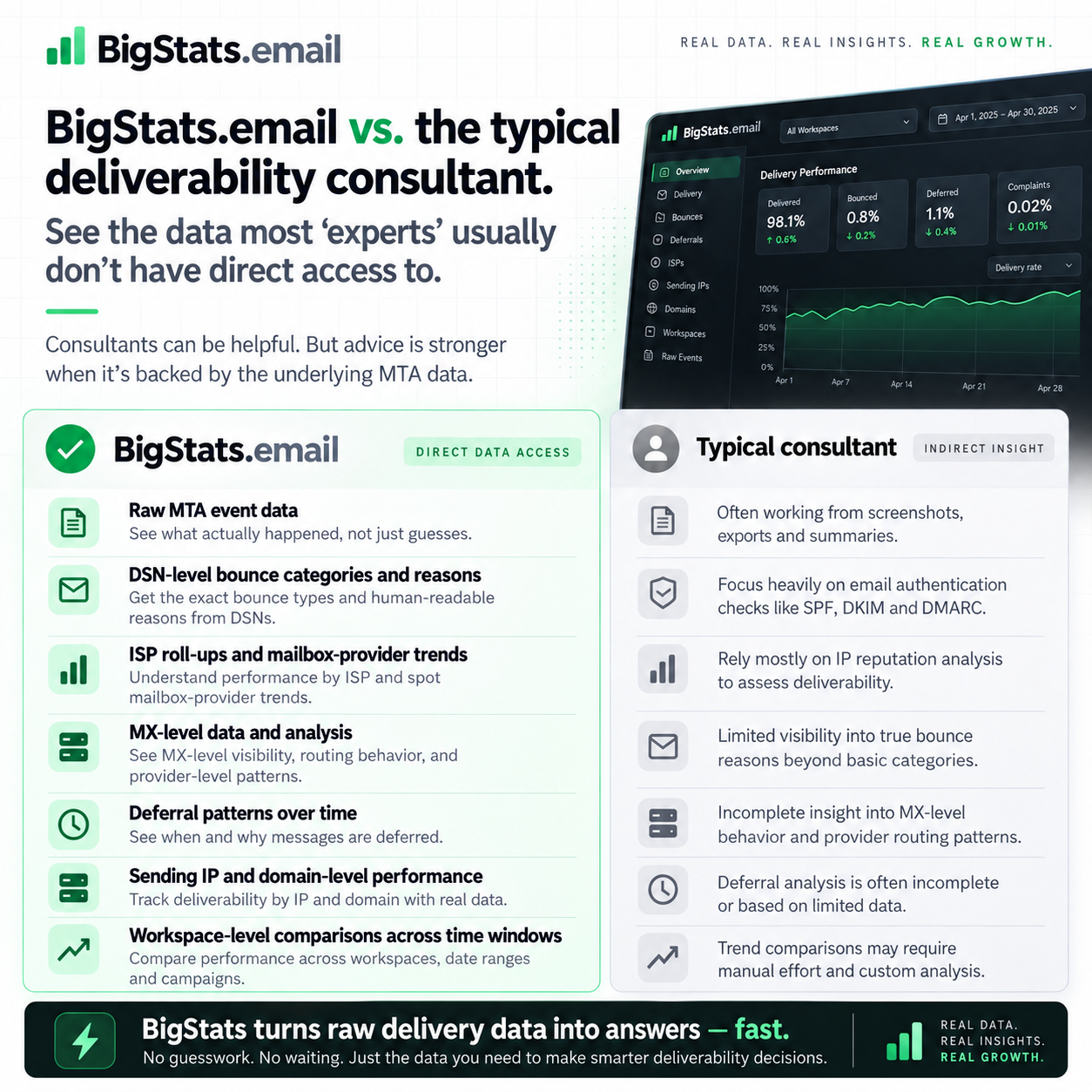
- Raw MTA event data — see what actually happened, message by message, not just guesses.
- DSN-level bounce categories and reasons, with the exact enhanced status codes and human-readable diagnostics.
- ISP roll-ups and mailbox-provider trends, so you can see performance the way receivers judge it.
- MX-level analysis — which receiving servers accepted, deferred or refused your mail, and how that shifts.
- Deferral patterns over time: when messages were deferred, why, and whether retries recovered them.
- Sending-IP and domain-level performance, including tenant and Virtual MTA breakdowns.
- Workspace-level comparisons across time windows and campaigns, on demand — no custom analysis project required.
Side by side
| Question | Typical consultant | BigStats |
|---|---|---|
| What did Gmail do with yesterday's send? | Wait for an export, then analyze it | Live ISP roll-up, updated continuously |
| Why did bounces spike? | Reason from category totals | Read the actual DSN codes and diagnostics |
| Is this deferral wave recovering? | Often unknown | Per-message retry outcomes, tracked to resolution |
| Which MX is the problem? | Rarely visible | Per-MX breakdown with connected domains |
| Compare this month to last | Manual spreadsheet work | Built-in time-window comparison |
| Did the fix work? | Re-engage and re-measure | Watch the same charts move |
Always on, not on retainer
The other structural difference is timing. A consultant engagement has a start, an end and an invoice in between. Delivery problems don't schedule themselves inside that window — a deferral wave at Gmail at 3am on a Saturday is invisible until Monday's call. BigStats watches continuously: alerts fire when bounce, deferral or complaint rates move, escalate while a condition persists, and go quiet the moment it resolves. The built-in analyst can answer "what changed at Microsoft this week?" against your real data at any hour, without waiting for anyone's calendar.
The strongest setup is both
Here's the part consultants tend to agree with once they see it: BigStats doesn't replace expertise, it arms it. A consultant working from your live BigStats data skips the two-week data-gathering phase and starts on interpretation. Their recommendations become testable — change the thing, watch the same per-ISP and per-MX charts, prove the fix worked. If you work with a deliverability consultant, giving them access to real event-level data is the highest-leverage thing you can do for the engagement. And if you don't, you may find you need one less often than you thought.
Point your MTA's event stream at BigStats and see the data most experts usually don't have direct access to. Start a free trial or see pricing.