Practical writing for delivery and deliverability teams: what receiving mailbox providers are actually telling you, how to read it fast, and how to prove a fix worked.
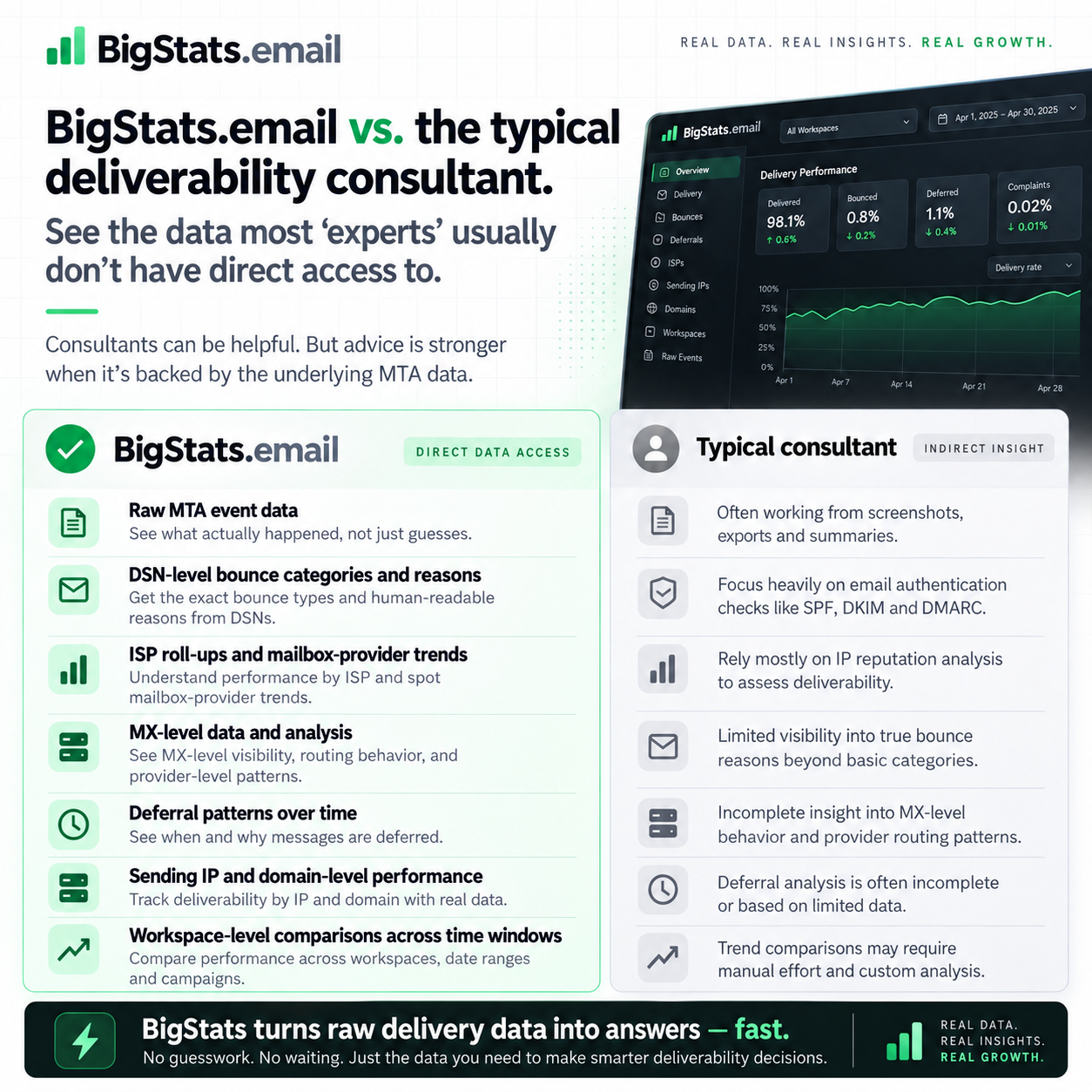
Consultants can be helpful. But advice is stronger when it's backed by the underlying MTA data — and most engagements never get direct access to it. Here's what changes when you do.
GreenArrow's Event Notification System already emits every signal you need. Here's how to monitor GreenArrow delivery health properly: which events matter, why deferrals move first, how to cut by VMTA and sending IP, and how to get alerted before a bounce wave.
KumoMTA's logs are excellent — and they are not a monitoring strategy. Here's what delivery-health monitoring on KumoMTA actually requires: the log records that matter, the signals that move first, and how to turn TransientFailure noise into an early-warning system.
SES configuration-set events now flow into BigStats over Amazon SNS with verified signatures and automatic subscription confirmation — the same delivery health, retries, alerts and analyst your GreenArrow, KumoMTA and SignalMTA traffic already gets.
Deliverability incidents are cheap to fix in the first hour and expensive to fix in the second week. Here's the alerting model BigStats ships — thresholds, per-domain anomalies, escalation, Slack and webhooks, and a daily digest — and why MailOps teams need all five.
An MTA dashboard tells you what your server did. Deliverability work needs to know what the receiving mailbox providers decided — and why. Here's the gap, and how BigStats closes it.